Cost and access · source-checked guide
Tirzepatide Cost in 2026: Current Zepbound Price Guide
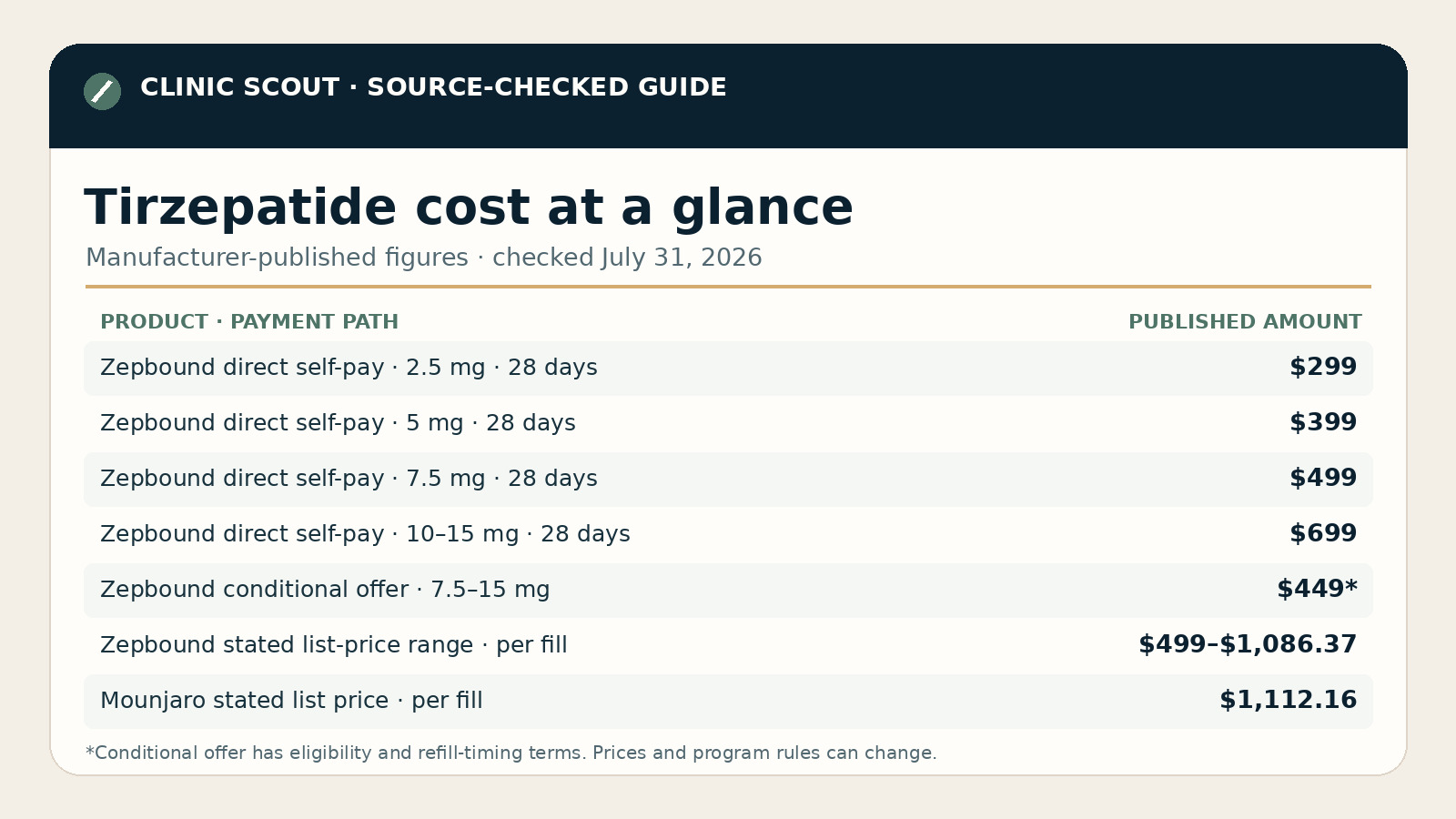
Sources current as of 2026-09-01 · Prices checked · Prices and terms can change.
Tirzepatide cost depends on product, dose, device, supply, insurance, and eligibility. Current Zepbound pages show one-month KwikPen prices of $299 to $699, a conditional commercial-insurance offer starting at $25, and a separate $449 higher-dose purchase offer. FDA updates do not provide a compounded-tirzepatide price. [S1][S2][S3]
Quick answer
> **Quick answer:** Tirzepatide cost depends on product, dose, device, supply, insurance, and eligibility. Current Zepbound pages show one-month KwikPen prices of $299 to $699, a conditional commercial-insurance offer starting at $25, and a separate $449 higher-dose purchase offer. FDA updates do not provide a compounded-tirzepatide price. [S1][S2][S3]
This page is a dated evidence guide, not a prescription, coverage decision, or price quote. The current numeric terms below come from Lilly's Zepbound savings and pricing pages captured September 1, 2026. The FDA section supplies a regulatory boundary, not a recommendation about a particular product, pharmacy, dose, or transaction. [S1][S2][S3]
The practical answer is not one universal monthly number. A patient may be looking for a list-price reference, a manufacturer self-pay amount, an insurance-processed amount, a savings-card floor, a Medicare program term, or the total cost of an online care program. Those are different price lanes. Combining them into one “tirzepatide cost” figure produces a misleading comparison.
What “tirzepatide cost” can mean
“Tirzepatide” is the active ingredient name. The current Lilly evidence reviewed for this refresh is specifically about Zepbound, a branded tirzepatide product. It does not establish a Mounjaro price, a compounded-product price, or a person-specific pharmacy total. Product identity must stay attached to every number. [S1][S3]
A list price is a manufacturer reference point, not an individual bill. Lilly says the amount a patient pays largely depends on the prescription-drug insurance plan and that pharmacy payment can also differ because of out-of-pocket rules, pharmacy charges, discounts, or financial assistance. [S3]
A direct-to-patient or self-pay amount is another lane. Lilly describes direct-to-patient price as the amount at which it sells directly to cash-paying patients and distinguishes that price from WAC. The amount may be tied to a particular device, dose, supply definition, offer, and purchase channel. [S1][S3]
A savings-card floor is conditional. Words such as “may be eligible,” “as low as,” and “starting at” do not mean that every insured or cash-paying patient receives the displayed amount. The offer pages state eligibility rules, government-program exclusions, savings limits, and terms. [S1]
Before comparing two amounts, label the product, device, dose, days supplied, payment lane, and checked date. A lower number in a different lane is not automatically a saving. [S1][S3]
| Price lane | What the number can answer |
|---|---|
| List price or WAC | A manufacturer reference amount per fill; not a guaranteed patient payment [S3] |
| Regular self-pay price | The displayed manufacturer cash price for the named device, dose, and one-month definition [S1] |
| Conditional savings floor | A possible amount for an eligible population under stated program rules [S1] |
| Insurance-processed amount | A plan-and-prescription-specific result; not stated for an individual in these captures [S3] |
| Total care-program cost | Medication plus any disclosed clinical, membership, lab, shipping, or other fees; not stated by Lilly's drug-price pages [S1][S3] |
Current Zepbound self-pay prices by displayed dose
The current Lilly savings page says the regular price for a one-month supply of Zepbound single-patient-use KwikPen is $299 for 2.5 mg, $399 for 5 mg, $499 for 7.5 mg, and $699 for 10 mg, 12.5 mg, and 15 mg. It also says additional taxes and fees may apply. These are displayed manufacturer terms, not a promise about every pharmacy or checkout. [S1]
The pricing page separately describes a self-pay presentation that includes a four-count single-dose vial and a single-patient-use KwikPen. The page associates the displayed dose sequence with direct-to-patient pricing, but readers should preserve the device wording rather than assume that one device's terms automatically apply to the other. [S3]
A “one-month” amount is not necessarily a calendar-month average. Lilly defines a monthly supply as 28 days. For the single-patient-use KwikPen, the savings terms define one month as 28 days and one KwikPen. For the commercial single-dose-pen offer, the page uses 28 days and up to four single-dose pens. [S1][S3]
The $299 through $699 table should therefore be read as a dated, device-labeled manufacturer price display. It does not state a person's final amount after insurance, taxes, fees, pharmacy charges, shipping, or a separate care subscription. Those fields require a separate readback. [S1][S3]
The official savings page also shows a separate “starting at $299” self-pay presentation for a one-month prescription of the KwikPen for single-patient use or four vials. That headline should not be used to erase the dose-specific regular-price table. A starting price and a dose-specific regular price answer different questions. [S1]
| Displayed Zepbound dose | Regular one-month KwikPen price |
|---|---|
| 2.5 mg | $299 [S1] |
| 5 mg | $399 [S1] |
| 7.5 mg | $499 [S1] |
| 10 mg | $699 [S1] |
| 12.5 mg | $699 [S1] |
| 15 mg | $699 [S1] |
The conditional $25 commercial-insurance lane
Lilly says people with commercial drug insurance that covers Zepbound may be eligible to pay as little as $25 for a one-, two-, or three-month prescription fill of Zepbound single-dose pen. The page defines the supply periods as 28, 56, or 84 days and up to four, eight, or twelve single-dose pens. [S1]
The same terms exclude governmental beneficiaries, require eligibility, impose monthly and annual savings limits, and state that the program is not insurance. The displayed $25 is therefore a conditional floor, not the general cash price and not a universal copay. [S1]
Do not apply the $25 term to a person until the exact product and device, coverage status, insurance type, prescription, and program eligibility are checked. The manufacturer page supplies offer mechanics; it does not adjudicate a plan claim or guarantee a pharmacy transaction. [S1]
A commercial plan can cover a product while still producing an amount different from the advertised floor because deductibles, copays, coinsurance, authorization, pharmacy network, benefit design, or program limits may affect the transaction. The reviewed pages do not state an individual's plan result. [S1][S3]
| $25-offer field | Current captured term |
|---|---|
| Insurance lane | Commercial drug insurance with coverage for Zepbound single-dose pen [S1] |
| Supply options | One, two, or three months; the page defines these as 28, 56, or 84 days [S1] |
| Savings limits | Up to $100, $200, or $300 maximum monthly savings for the corresponding fill, plus a separate annual maximum of up to $1,300 [S1] |
| Eligibility exclusions | Government-funded healthcare program beneficiaries are excluded from the cited offer [S1] |
| Program status | The page states: “PROGRAM IS NOT INSURANCE.” [S1] |
The separate $449 higher-dose purchase offer
The current savings page contains another lane for eligible patients with commercial drug insurance that does not cover the Zepbound single-patient-use KwikPen. It says eligible patients may pay as low as $299 for 2.5 mg, $399 for 5 mg, $449 for 7.5 mg, and $449 for 10 mg, 12.5 mg, or 15 mg under the stated terms. [S1]
That $449 amount is not the same claim as the regular $499 or $699 table. The page says savings on the higher-dose KwikPens are subject to Purchase Offer Terms and Conditions. It also says a one-month supply is 28 days and one KwikPen, and that a card may be used for up to eleven prescription fills per calendar year. [S1]
The page further states that the $449 purchase offer is automatically received on the first purchase of the named higher doses and that continued eligibility requires completing a refill purchase within 45 days of the delivery or received date of the previous fill. It says new and existing patients are eligible, subject to the offer's other conditions. [S1]
This is a good example of why a single “tirzepatide cost” number fails. The same page contains a regular price, a conditional purchase offer, and a separate commercial-insurance single-dose-pen offer. Each amount carries its own device, coverage, supply, limit, and timing terms. [S1]
Keep the $449 term labeled as a purchase offer. Do not call it a universal self-pay price, an insurance copay, or a guaranteed recurring amount. Reopen the current terms before paying because the page says additional conditions apply and a program can change. [S1]
Insurance, Medicare, and total cost
Lilly's pricing information page says the amount a patient pays will largely depend on the prescription-drug insurance plan and directs readers to their insurance provider for the most accurate plan information. The reviewed captures do not provide a deductible status, formulary tier, prior-authorization decision, network result, or final claim amount for an individual. [S3]
A useful insurance check asks whether the plan covers the exact branded product, whether the prescription is for an approved use consistent with labeling, whether authorization is required, whether the selected pharmacy is in network, and whether a manufacturer offer permits the person's benefit type. A general “I have insurance” answer is not enough. [S1][S3]
The savings page also describes a Medicare GLP-1 Bridge lane in which eligible Medicare Part D patients may be able to get Zepbound for no more than $50 per month, with terms applying and no guarantee of coverage. That statement is a program term, not a determination that any particular patient qualifies or that a plan will pay the amount. [S1]
Total cost is not necessarily the medication line alone. If an online program adds clinical or membership fees, those charges must be itemized separately and should not be inserted into the Zepbound medication table without a source stating that the medicine is included. [S1][S3]
For a broader worksheet, see the GLP-1 program total-cost comparison. For manufacturer assistance terminology, see the Lilly assistance and savings guide. Those related guides do not replace a current plan or transaction readback.
| Cost component | What to verify separately |
|---|---|
| Medication amount | Product, device, dose, quantity, days supplied, and price lane [S1][S3] |
| Insurance processing | Coverage, deductible, copay or coinsurance, formulary, authorization, and pharmacy network [S3] |
| Manufacturer offer | Eligibility, government-program exclusion, limits, expiry or offer terms, and exact device [S1] |
| Care or service fees | Consultation, membership, labs, follow-up, supplies, shipping, taxes, and cancellation terms; not stated on the Lilly drug-price pages [S1][S3] |
What the FDA's April 2026 compounding update changes
The FDA announced on April 30, 2026 that it proposed excluding semaglutide, tirzepatide, and liraglutide from the 503B bulks list after finding no clinical need for outsourcing facilities to compound those drugs from bulk substances. This is a new regulatory source for this refresh; it is not a price source. [S2]
The FDA explains that the 503B bulks list identifies bulk substances that outsourcing facilities may use under section 503B. It says that, in most cases, an outsourcing facility cannot compound from a bulk substance unless the substance appears on that list or the compounded drug is on the FDA drug-shortage list at the relevant time of compounding, distribution, and dispensing. [S2]
The FDA also says the agency did not identify sufficient evidence to include the three substances on the 503B bulks list and that a clinical-need determination is based on patient safety and medical necessity under the law. The proposal invited comments through June 29, 2026 before a final determination. [S2]
This update does not establish that every compounded tirzepatide transaction is identical, lawful, unlawful, available, unavailable, safe, unsafe, or suitable for a particular person. It describes an FDA proposal and the federal 503B bulk-substance framework. State law, facility status, prescription facts, shortage status, formulation, and transaction timing may require separate verification. [S2]
The FDA page does not state a compounded-tirzepatide price. Do not compare an unsourced compounded quote with a branded Zepbound manufacturer term as though the products, devices, services, regulatory evidence, and payment lanes were interchangeable. [S1][S2]
For a separate regulatory-status explainer, see the compounded tirzepatide versus Zepbound guide. The current article keeps the FDA proposal, Lilly pricing, and any person-specific clinical decision in separate lanes.
| FDA evidence lane | What it does not establish |
|---|---|
| Proposed 503B bulks-list exclusion | A final determination for every facility or transaction [S2] |
| Bulk-substance compounding rule | That a particular product meets all federal or state requirements [S2] |
| No clinical need identified in the proposal | A clinical recommendation or personal treatment decision [S2] |
| Public comment deadline | Current availability, price, quality, or suitability of a specific product [S2] |
Build a dated cost worksheet
A good worksheet prevents a headline price from becoming a false promise. Record the exact fields below for every quote or offer. [S1][S3]
Mark a field “not stated” when the source does not provide it. Do not estimate a missing fee from a different program or carry an old number into a current table without a current first-party confirmation. [S1][S2][S3]
For an insurance quote, save the date and exact prescription attached to the estimate. A benefit result can change after deductible activity, authorization, pharmacy selection, a plan-year change, or a program-term change. This guide organizes the verification record; it does not predict the result. [S1][S3]
| Worksheet field | Required readback |
|---|---|
| Product identity | Zepbound, another branded product, or a clearly identified compounded product; do not record “tirzepatide” alone [S1][S2] |
| Device and dose | Single-dose pen, KwikPen, vial, strength, quantity, and any missing device field [S1][S3] |
| Supply period | 28, 56, or 84 days, package count, and refill timing [S1][S3] |
| Price category | List/WAC, regular self-pay, conditional offer, insurance-processed, pharmacy cash, or bundled program [S1][S3] |
| Eligibility | Commercial or government-benefit status, coverage, offer determination, and limits [S1] |
| Added charges | Taxes, fees, shipping, consultation, labs, membership, supplies, refill, or cancellation amounts [S1][S3] |
| Evidence receipt | Exact URL, capture date, displayed terms, and final itemized quote source [S1][S2][S3] |
Common errors when comparing tirzepatide costs
The first error is treating a list price as a patient bill. Lilly separates list or WAC language from patient payment and says insurance and pharmacy factors can change the amount. Label the category every time. [S3]
The second error is treating $25 as a no-insurance price. The captured offer requires commercial coverage for the named single-dose pen, excludes governmental beneficiaries, and imposes limits. It is a conditional offer floor. [S1]
The third error is blending the regular KwikPen table with the $449 purchase offer. The current page gives different conditions, device terms, and limits. Keep the offer lane separate from regular price. [S1]
The fourth error is treating “one month” as a universal calendar period. The reviewed terms define a month as 28 days and attach different package limits to different devices. Record days and quantity. [S1][S3]
The fifth error is treating the FDA proposal as a compounded-product price or a personal medical answer. It is regulatory evidence about the 503B bulk-substance framework, not a quote, diagnosis, prescription, or suitability determination. [S2]
The sixth error is assuming a medication headline includes care or delivery. Ask for an itemized total and keep medicine, clinician services, labs, shipping, taxes, and membership charges in separate fields. [S1][S3]
Verification workflow before paying
This process does not guarantee a lower price. It creates a dated, like-for-like record so that a list price, a conditional floor, a purchase offer, a plan result, and a final transaction are not mislabeled as one number. [S1][S3]
- Copy the exact product, device, dose, quantity, and days supplied from the prescription or offer.
- Classify the amount as list/WAC, regular self-pay, conditional savings, insurance-processed, pharmacy cash, or bundled program.
- Open the current first-party page and record the checked date; do not substitute a stale screenshot or old release.
- Read the eligibility, government-program, savings-limit, device, refill, and “not insurance” language attached to the amount.
- Ask the plan, pharmacy, manufacturer program, or care service for an itemized amount tied to the exact prescription.
- Record every stated fee and mark every missing field “not stated.”
- Recheck after any change in product, device, dose, pharmacy, insurance, program, refill timing, or source page.
What these captures do not state
The captures do not state an individual's final insured cost, deductible status, formulary tier, authorization result, pharmacy network status, savings eligibility decision, or checkout total. They do not state a current Mounjaro price or a compounded-tirzepatide price. [S1][S2][S3]
The Lilly pages describe specific Zepbound devices and offers. They do not provide a complete device-by-dose availability matrix for every channel, nor do they establish that every displayed offer is available to every patient. [S1][S3]
The FDA proposal does not decide the legal status of a particular compounded prescription or facility in every jurisdiction. It also does not determine what treatment is appropriate, whether a medicine should be used, or what outcome to expect. Those questions require qualified clinical and regulatory review. [S2]
Frequently asked questions
How much does tirzepatide cost in 2026?
There is no single universal amount. For Zepbound, the current Lilly savings page displays regular one-month KwikPen prices from $299 to $699 by displayed dose, plus separate conditional offers. An individual's insured amount, pharmacy total, and added care fees are not stated in these captures. [S1][S3]
Is Zepbound $25 for everyone with insurance?
No. Lilly ties the $25 floor to eligible people with commercial drug insurance covering Zepbound single-dose pen. The page excludes governmental beneficiaries, applies savings limits and other terms, and says the program is not insurance. [S1]
What are the current Zepbound self-pay prices by dose?
The captured regular one-month KwikPen schedule is $299 for 2.5 mg, $399 for 5 mg, $499 for 7.5 mg, and $699 for 10 mg, 12.5 mg, and 15 mg. Additional taxes and fees may apply, and the page's device and supply conditions remain attached to the table. [S1]
What is the $449 Zepbound offer?
The savings page describes a separate purchase offer for eligible higher-dose single-patient-use KwikPen fills. It lists $449 for 7.5 mg, 10 mg, 12.5 mg, or 15 mg under stated conditions, including refill timing and other Purchase Offer Terms and Conditions. It is not a universal cash price. [S1]
What does one month mean on the Zepbound page?
The reviewed terms define a one-month supply as 28 days. The KwikPen terms specify one KwikPen, while the commercial single-dose-pen offer uses up to four pens for one month. Record days and package count before comparing amounts. [S1][S3]
Does this page give a Mounjaro price?
No. The numeric evidence captured for this article is tied to Zepbound pages. The reviewed sources do not provide a current Mounjaro price, so a Mounjaro amount remains not stated here rather than being inferred from the shared ingredient name. [S1][S3]
How much does compounded tirzepatide cost?
Not stated in the reviewed captures. The FDA source describes a proposed 503B bulks-list action and the relevant federal framework, but it does not provide a compounded-product price or resolve the status of a particular transaction. [S2]
Is compounded tirzepatide FDA approved?
The FDA source explains the federal compounding framework and says its April 2026 proposal found no clinical need to add the named substances to the 503B bulks list. That source does not decide the status of every compounded product or facility, and it is not a personal medical recommendation. [S2]
What should I verify before paying?
Verify product, device, dose, quantity, days supplied, price category, insurance processing, offer eligibility, pharmacy or dispensing entity, included services, taxes and fees, refill timing, cancellation terms, source URL, and checked date. Ask for a final itemized amount tied to the exact prescription. [S1][S2][S3]
Can this guide tell me whether tirzepatide is right for me?
No. This page organizes current commercial and regulatory evidence. It does not diagnose, prescribe, determine eligibility, advise switching, select a dose, or predict an outcome. Discuss personal treatment questions with a qualified clinician or pharmacist.
What to verify
Confirm
- Uses current primary evidence.
- Separates verified facts from unknowns.
- Maps decision-bearing claims to captured source text.
Do not assume
- Terms, prices, labels, and coverage can change.
- Individual outcomes and eligibility cannot be inferred from general evidence.
- The page cannot replace clinician, plan, or pharmacy verification.
Verified claims
Each statement below is bound to its numbered source.
Open the claim-to-source map (83 claims)
- > **Quick answer:** Tirzepatide cost depends on product, dose, device, supply, insurance, and eligibility. Current Zepbound pages show one-month KwikPen prices of $299 to $699, a conditional commercial-insurance offer starting at $25, and a separate $449 higher-dose purchase offer. FDA updates do not provide a compounded-tirzepatide price.123
- This page is a dated evidence guide, not a prescription, coverage decision, or price quote. The current numeric terms below come from Lilly's Zepbound savings and pricing pages captured September 1, 2026. The FDA section supplies a regulatory boundary, not a recommendation about a particular product, pharmacy, dose, or transaction.123
- “Tirzepatide” is the active ingredient name. The current Lilly evidence reviewed for this refresh is specifically about Zepbound, a branded tirzepatide product. It does not establish a Mounjaro price, a compounded-product price, or a person-specific pharmacy total. Product identity must stay attached to every number.13
- A list price is a manufacturer reference point, not an individual bill. Lilly says the amount a patient pays largely depends on the prescription-drug insurance plan and that pharmacy payment can also differ because of out-of-pocket rules, pharmacy charges, discounts, or financial assistance.3
- A direct-to-patient or self-pay amount is another lane. Lilly describes direct-to-patient price as the amount at which it sells directly to cash-paying patients and distinguishes that price from WAC. The amount may be tied to a particular device, dose, supply definition, offer, and purchase channel.13
- A savings-card floor is conditional. Words such as “may be eligible,” “as low as,” and “starting at” do not mean that every insured or cash-paying patient receives the displayed amount. The offer pages state eligibility rules, government-program exclusions, savings limits, and terms.1
- | List price or WAC | A manufacturer reference amount per fill; not a guaranteed patient payment |3
- | Regular self-pay price | The displayed manufacturer cash price for the named device, dose, and one-month definition |1
- | Conditional savings floor | A possible amount for an eligible population under stated program rules |1
- | Insurance-processed amount | A plan-and-prescription-specific result; not stated for an individual in these captures |3
- | Total care-program cost | Medication plus any disclosed clinical, membership, lab, shipping, or other fees; not stated by Lilly's drug-price pages |13
- Before comparing two amounts, label the product, device, dose, days supplied, payment lane, and checked date. A lower number in a different lane is not automatically a saving.13
- The current Lilly savings page says the regular price for a one-month supply of Zepbound single-patient-use KwikPen is $299 for 2.5 mg, $399 for 5 mg, $499 for 7.5 mg, and $699 for 10 mg, 12.5 mg, and 15 mg. It also says additional taxes and fees may apply. These are displayed manufacturer terms, not a promise about every pharmacy or checkout.1
- | 2.5 mg | $299 |1
- | 5 mg | $399 |1
- | 7.5 mg | $499 |1
- | 10 mg | $699 |1
- | 12.5 mg | $699 |1
- | 15 mg | $699 |1
- The pricing page separately describes a self-pay presentation that includes a four-count single-dose vial and a single-patient-use KwikPen. The page associates the displayed dose sequence with direct-to-patient pricing, but readers should preserve the device wording rather than assume that one device's terms automatically apply to the other.3
- A “one-month” amount is not necessarily a calendar-month average. Lilly defines a monthly supply as 28 days. For the single-patient-use KwikPen, the savings terms define one month as 28 days and one KwikPen. For the commercial single-dose-pen offer, the page uses 28 days and up to four single-dose pens.13
- The $299 through $699 table should therefore be read as a dated, device-labeled manufacturer price display. It does not state a person's final amount after insurance, taxes, fees, pharmacy charges, shipping, or a separate care subscription. Those fields require a separate readback.13
- The official savings page also shows a separate “starting at $299” self-pay presentation for a one-month prescription of the KwikPen for single-patient use or four vials. That headline should not be used to erase the dose-specific regular-price table. A starting price and a dose-specific regular price answer different questions.1
- Lilly says people with commercial drug insurance that covers Zepbound may be eligible to pay as little as $25 for a one-, two-, or three-month prescription fill of Zepbound single-dose pen. The page defines the supply periods as 28, 56, or 84 days and up to four, eight, or twelve single-dose pens.1
- The same terms exclude governmental beneficiaries, require eligibility, impose monthly and annual savings limits, and state that the program is not insurance. The displayed $25 is therefore a conditional floor, not the general cash price and not a universal copay.1
- | Insurance lane | Commercial drug insurance with coverage for Zepbound single-dose pen |1
- | Supply options | One, two, or three months; the page defines these as 28, 56, or 84 days |1
- | Savings limits | Up to $100, $200, or $300 maximum monthly savings for the corresponding fill, plus a separate annual maximum of up to $1,300 |1
- | Eligibility exclusions | Government-funded healthcare program beneficiaries are excluded from the cited offer |1
- | Program status | The page states: “PROGRAM IS NOT INSURANCE.” |1
- Do not apply the $25 term to a person until the exact product and device, coverage status, insurance type, prescription, and program eligibility are checked. The manufacturer page supplies offer mechanics; it does not adjudicate a plan claim or guarantee a pharmacy transaction.1
- A commercial plan can cover a product while still producing an amount different from the advertised floor because deductibles, copays, coinsurance, authorization, pharmacy network, benefit design, or program limits may affect the transaction. The reviewed pages do not state an individual's plan result.13
- The current savings page contains another lane for eligible patients with commercial drug insurance that does not cover the Zepbound single-patient-use KwikPen. It says eligible patients may pay as low as $299 for 2.5 mg, $399 for 5 mg, $449 for 7.5 mg, and $449 for 10 mg, 12.5 mg, or 15 mg under the stated terms.1
- That $449 amount is not the same claim as the regular $499 or $699 table. The page says savings on the higher-dose KwikPens are subject to Purchase Offer Terms and Conditions. It also says a one-month supply is 28 days and one KwikPen, and that a card may be used for up to eleven prescription fills per calendar year.1
- The page further states that the $449 purchase offer is automatically received on the first purchase of the named higher doses and that continued eligibility requires completing a refill purchase within 45 days of the delivery or received date of the previous fill. It says new and existing patients are eligible, subject to the offer's other conditions.1
- This is a good example of why a single “tirzepatide cost” number fails. The same page contains a regular price, a conditional purchase offer, and a separate commercial-insurance single-dose-pen offer. Each amount carries its own device, coverage, supply, limit, and timing terms.1
- Keep the $449 term labeled as a purchase offer. Do not call it a universal self-pay price, an insurance copay, or a guaranteed recurring amount. Reopen the current terms before paying because the page says additional conditions apply and a program can change.1
- Lilly's pricing information page says the amount a patient pays will largely depend on the prescription-drug insurance plan and directs readers to their insurance provider for the most accurate plan information. The reviewed captures do not provide a deductible status, formulary tier, prior-authorization decision, network result, or final claim amount for an individual.3
- A useful insurance check asks whether the plan covers the exact branded product, whether the prescription is for an approved use consistent with labeling, whether authorization is required, whether the selected pharmacy is in network, and whether a manufacturer offer permits the person's benefit type. A general “I have insurance” answer is not enough.13
- The savings page also describes a Medicare GLP-1 Bridge lane in which eligible Medicare Part D patients may be able to get Zepbound for no more than $50 per month, with terms applying and no guarantee of coverage. That statement is a program term, not a determination that any particular patient qualifies or that a plan will pay the amount.1
- | Medication amount | Product, device, dose, quantity, days supplied, and price lane |13
- | Insurance processing | Coverage, deductible, copay or coinsurance, formulary, authorization, and pharmacy network |3
- | Manufacturer offer | Eligibility, government-program exclusion, limits, expiry or offer terms, and exact device |1
- | Care or service fees | Consultation, membership, labs, follow-up, supplies, shipping, taxes, and cancellation terms; not stated on the Lilly drug-price pages |13
- Total cost is not necessarily the medication line alone. If an online program adds clinical or membership fees, those charges must be itemized separately and should not be inserted into the Zepbound medication table without a source stating that the medicine is included.13
- The FDA announced on April 30, 2026 that it proposed excluding semaglutide, tirzepatide, and liraglutide from the 503B bulks list after finding no clinical need for outsourcing facilities to compound those drugs from bulk substances. This is a new regulatory source for this refresh; it is not a price source.2
- The FDA explains that the 503B bulks list identifies bulk substances that outsourcing facilities may use under section 503B. It says that, in most cases, an outsourcing facility cannot compound from a bulk substance unless the substance appears on that list or the compounded drug is on the FDA drug-shortage list at the relevant time of compounding, distribution, and dispensing.2
- The FDA also says the agency did not identify sufficient evidence to include the three substances on the 503B bulks list and that a clinical-need determination is based on patient safety and medical necessity under the law. The proposal invited comments through June 29, 2026 before a final determination.2
- This update does not establish that every compounded tirzepatide transaction is identical, lawful, unlawful, available, unavailable, safe, unsafe, or suitable for a particular person. It describes an FDA proposal and the federal 503B bulk-substance framework. State law, facility status, prescription facts, shortage status, formulation, and transaction timing may require separate verification.2
- | Proposed 503B bulks-list exclusion | A final determination for every facility or transaction |2
- | Bulk-substance compounding rule | That a particular product meets all federal or state requirements |2
- | No clinical need identified in the proposal | A clinical recommendation or personal treatment decision |2
- | Public comment deadline | Current availability, price, quality, or suitability of a specific product |2
- The FDA page does not state a compounded-tirzepatide price. Do not compare an unsourced compounded quote with a branded Zepbound manufacturer term as though the products, devices, services, regulatory evidence, and payment lanes were interchangeable.12
- A good worksheet prevents a headline price from becoming a false promise. Record the exact fields below for every quote or offer.13
- | Product identity | Zepbound, another branded product, or a clearly identified compounded product; do not record “tirzepatide” alone |12
- | Device and dose | Single-dose pen, KwikPen, vial, strength, quantity, and any missing device field |13
- | Supply period | 28, 56, or 84 days, package count, and refill timing |13
- | Price category | List/WAC, regular self-pay, conditional offer, insurance-processed, pharmacy cash, or bundled program |13
- | Eligibility | Commercial or government-benefit status, coverage, offer determination, and limits |1
- | Added charges | Taxes, fees, shipping, consultation, labs, membership, supplies, refill, or cancellation amounts |13
- | Evidence receipt | Exact URL, capture date, displayed terms, and final itemized quote source |123
- Mark a field “not stated” when the source does not provide it. Do not estimate a missing fee from a different program or carry an old number into a current table without a current first-party confirmation.123
- For an insurance quote, save the date and exact prescription attached to the estimate. A benefit result can change after deductible activity, authorization, pharmacy selection, a plan-year change, or a program-term change. This guide organizes the verification record; it does not predict the result.13
- The first error is treating a list price as a patient bill. Lilly separates list or WAC language from patient payment and says insurance and pharmacy factors can change the amount. Label the category every time.3
- The second error is treating $25 as a no-insurance price. The captured offer requires commercial coverage for the named single-dose pen, excludes governmental beneficiaries, and imposes limits. It is a conditional offer floor.1
- The third error is blending the regular KwikPen table with the $449 purchase offer. The current page gives different conditions, device terms, and limits. Keep the offer lane separate from regular price.1
- The fourth error is treating “one month” as a universal calendar period. The reviewed terms define a month as 28 days and attach different package limits to different devices. Record days and quantity.13
- The fifth error is treating the FDA proposal as a compounded-product price or a personal medical answer. It is regulatory evidence about the 503B bulk-substance framework, not a quote, diagnosis, prescription, or suitability determination.2
- The sixth error is assuming a medication headline includes care or delivery. Ask for an itemized total and keep medicine, clinician services, labs, shipping, taxes, and membership charges in separate fields.13
- This process does not guarantee a lower price. It creates a dated, like-for-like record so that a list price, a conditional floor, a purchase offer, a plan result, and a final transaction are not mislabeled as one number.13
- The captures do not state an individual's final insured cost, deductible status, formulary tier, authorization result, pharmacy network status, savings eligibility decision, or checkout total. They do not state a current Mounjaro price or a compounded-tirzepatide price.123
- The Lilly pages describe specific Zepbound devices and offers. They do not provide a complete device-by-dose availability matrix for every channel, nor do they establish that every displayed offer is available to every patient.13
- The FDA proposal does not decide the legal status of a particular compounded prescription or facility in every jurisdiction. It also does not determine what treatment is appropriate, whether a medicine should be used, or what outcome to expect. Those questions require qualified clinical and regulatory review.2
- There is no single universal amount. For Zepbound, the current Lilly savings page displays regular one-month KwikPen prices from $299 to $699 by displayed dose, plus separate conditional offers. An individual's insured amount, pharmacy total, and added care fees are not stated in these captures.13
- No. Lilly ties the $25 floor to eligible people with commercial drug insurance covering Zepbound single-dose pen. The page excludes governmental beneficiaries, applies savings limits and other terms, and says the program is not insurance.1
- The captured regular one-month KwikPen schedule is $299 for 2.5 mg, $399 for 5 mg, $499 for 7.5 mg, and $699 for 10 mg, 12.5 mg, and 15 mg. Additional taxes and fees may apply, and the page's device and supply conditions remain attached to the table.1
- The savings page describes a separate purchase offer for eligible higher-dose single-patient-use KwikPen fills. It lists $449 for 7.5 mg, 10 mg, 12.5 mg, or 15 mg under stated conditions, including refill timing and other Purchase Offer Terms and Conditions. It is not a universal cash price.1
- The reviewed terms define a one-month supply as 28 days. The KwikPen terms specify one KwikPen, while the commercial single-dose-pen offer uses up to four pens for one month. Record days and package count before comparing amounts.13
- No. The numeric evidence captured for this article is tied to Zepbound pages. The reviewed sources do not provide a current Mounjaro price, so a Mounjaro amount remains not stated here rather than being inferred from the shared ingredient name.13
- Not stated in the reviewed captures. The FDA source describes a proposed 503B bulks-list action and the relevant federal framework, but it does not provide a compounded-product price or resolve the status of a particular transaction.2
- The FDA source explains the federal compounding framework and says its April 2026 proposal found no clinical need to add the named substances to the 503B bulks list. That source does not decide the status of every compounded product or facility, and it is not a personal medical recommendation.2
- Verify product, device, dose, quantity, days supplied, price category, insurance processing, offer eligibility, pharmacy or dispensing entity, included services, taxes and fees, refill timing, cancellation terms, source URL, and checked date. Ask for a final itemized amount tied to the exact prescription.123
Facts to compare
Open the source-bound fact recap (8 rows)
| Question | Published fact | Evidence |
|---|---|---|
| Cost | > **Quick answer:** Tirzepatide cost depends on product, dose, device, supply, insurance, and eligibility. Current Zepbound pages show one-month KwikPen prices of $299 to $699, a conditional commercial-insurance offer starting at $25, and a separate $449 higher-dose purchase offer. FDA updates do not provide a compounded-tirzepatide price. | Mapped claim |
| Cost | This page is a dated evidence guide, not a prescription, coverage decision, or price quote. The current numeric terms below come from Lilly's Zepbound savings and pricing pages captured September 1, 2026. The FDA section supplies a regulatory boundary, not a recommendation about a particular product, pharmacy, dose, or transaction. | Mapped claim |
| Cost | “Tirzepatide” is the active ingredient name. The current Lilly evidence reviewed for this refresh is specifically about Zepbound, a branded tirzepatide product. It does not establish a Mounjaro price, a compounded-product price, or a person-specific pharmacy total. Product identity must stay attached to every number. | Mapped claim |
| Cost | A list price is a manufacturer reference point, not an individual bill. Lilly says the amount a patient pays largely depends on the prescription-drug insurance plan and that pharmacy payment can also differ because of out-of-pocket rules, pharmacy charges, discounts, or financial assistance. | Mapped claim |
| Cost | A direct-to-patient or self-pay amount is another lane. Lilly describes direct-to-patient price as the amount at which it sells directly to cash-paying patients and distinguishes that price from WAC. The amount may be tied to a particular device, dose, supply definition, offer, and purchase channel. | Mapped claim |
| Eligibility or terms | A savings-card floor is conditional. Words such as “may be eligible,” “as low as,” and “starting at” do not mean that every insured or cash-paying patient receives the displayed amount. The offer pages state eligibility rules, government-program exclusions, savings limits, and terms. | Mapped claim |
| Cost | | List price or WAC | A manufacturer reference amount per fill; not a guaranteed patient payment | | Mapped claim |
| Cost | | Regular self-pay price | The displayed manufacturer cash price for the named device, dose, and one-month definition | | Mapped claim |
Quick evidence check
What the sources establish
- Uses current primary evidence.
- Separates verified facts from unknowns.
- Maps decision-bearing claims to captured source text.
What still needs verification
- Terms, prices, labels, and coverage can change.
- Individual outcomes and eligibility cannot be inferred from general evidence.
- The page cannot replace clinician, plan, or pharmacy verification.
Sources and what they support
- Eli Lilly and CompanySupports: > **Quick answer:** Tirzepatide cost depends on product, dose, device, supply, insurance, and eligibility. Current Zepbound pages show one-month KwikPen prices of $299 to $699, a conditional commercial-insurance offer starting at $25, and a separate $449 higher-dose purchase offer. FDA updates do not provide a compounded-tirzepatide price. · This page is a dated evidence guide, not a prescription, coverage decision, or price quote. The current numeric terms below come from Lilly's Zepbound savings and pricing pages captured September 1, 2026. The FDA section supplies a regulatory boundary, not a recommendation about a particular product, pharmacy, dose, or transaction. · “Tirzepatide” is the active ingredient name. The current Lilly evidence reviewed for this refresh is specifically about Zepbound, a branded tirzepatide product. It does not establish a Mounjaro price, a compounded-product price, or a person-specific pharmacy total. Product identity must stay attached to every number. · A direct-to-patient or self-pay amount is another lane. Lilly describes direct-to-patient price as the amount at which it sells directly to cash-paying patients and distinguishes that price from WAC. The amount may be tied to a particular device, dose, supply definition, offer, and purchase channel. · A savings-card floor is conditional. Words such as “may be eligible,” “as low as,” and “starting at” do not mean that every insured or cash-paying patient receives the displayed amount. The offer pages state eligibility rules, government-program exclusions, savings limits, and terms. · | Regular self-pay price | The displayed manufacturer cash price for the named device, dose, and one-month definition | · | Conditional savings floor | A possible amount for an eligible population under stated program rules | · | Total care-program cost | Medication plus any disclosed clinical, membership, lab, shipping, or other fees; not stated by Lilly's drug-price pages | · Before comparing two amounts, label the product, device, dose, days supplied, payment lane, and checked date. A lower number in a different lane is not automatically a saving. · The current Lilly savings page says the regular price for a one-month supply of Zepbound single-patient-use KwikPen is $299 for 2.5 mg, $399 for 5 mg, $499 for 7.5 mg, and $699 for 10 mg, 12.5 mg, and 15 mg. It also says additional taxes and fees may apply. These are displayed manufacturer terms, not a promise about every pharmacy or checkout. · | 2.5 mg | $299 | · | 5 mg | $399 | · | 7.5 mg | $499 | · | 10 mg | $699 | · | 12.5 mg | $699 | · | 15 mg | $699 | · A “one-month” amount is not necessarily a calendar-month average. Lilly defines a monthly supply as 28 days. For the single-patient-use KwikPen, the savings terms define one month as 28 days and one KwikPen. For the commercial single-dose-pen offer, the page uses 28 days and up to four single-dose pens. · The $299 through $699 table should therefore be read as a dated, device-labeled manufacturer price display. It does not state a person's final amount after insurance, taxes, fees, pharmacy charges, shipping, or a separate care subscription. Those fields require a separate readback. · The official savings page also shows a separate “starting at $299” self-pay presentation for a one-month prescription of the KwikPen for single-patient use or four vials. That headline should not be used to erase the dose-specific regular-price table. A starting price and a dose-specific regular price answer different questions. · Lilly says people with commercial drug insurance that covers Zepbound may be eligible to pay as little as $25 for a one-, two-, or three-month prescription fill of Zepbound single-dose pen. The page defines the supply periods as 28, 56, or 84 days and up to four, eight, or twelve single-dose pens. · The same terms exclude governmental beneficiaries, require eligibility, impose monthly and annual savings limits, and state that the program is not insurance. The displayed $25 is therefore a conditional floor, not the general cash price and not a universal copay. · | Insurance lane | Commercial drug insurance with coverage for Zepbound single-dose pen | · | Supply options | One, two, or three months; the page defines these as 28, 56, or 84 days | · | Savings limits | Up to $100, $200, or $300 maximum monthly savings for the corresponding fill, plus a separate annual maximum of up to $1,300 | · | Eligibility exclusions | Government-funded healthcare program beneficiaries are excluded from the cited offer | · | Program status | The page states: “PROGRAM IS NOT INSURANCE.” | · Do not apply the $25 term to a person until the exact product and device, coverage status, insurance type, prescription, and program eligibility are checked. The manufacturer page supplies offer mechanics; it does not adjudicate a plan claim or guarantee a pharmacy transaction. · A commercial plan can cover a product while still producing an amount different from the advertised floor because deductibles, copays, coinsurance, authorization, pharmacy network, benefit design, or program limits may affect the transaction. The reviewed pages do not state an individual's plan result. · The current savings page contains another lane for eligible patients with commercial drug insurance that does not cover the Zepbound single-patient-use KwikPen. It says eligible patients may pay as low as $299 for 2.5 mg, $399 for 5 mg, $449 for 7.5 mg, and $449 for 10 mg, 12.5 mg, or 15 mg under the stated terms. · That $449 amount is not the same claim as the regular $499 or $699 table. The page says savings on the higher-dose KwikPens are subject to Purchase Offer Terms and Conditions. It also says a one-month supply is 28 days and one KwikPen, and that a card may be used for up to eleven prescription fills per calendar year. · The page further states that the $449 purchase offer is automatically received on the first purchase of the named higher doses and that continued eligibility requires completing a refill purchase within 45 days of the delivery or received date of the previous fill. It says new and existing patients are eligible, subject to the offer's other conditions. · This is a good example of why a single “tirzepatide cost” number fails. The same page contains a regular price, a conditional purchase offer, and a separate commercial-insurance single-dose-pen offer. Each amount carries its own device, coverage, supply, limit, and timing terms. · Keep the $449 term labeled as a purchase offer. Do not call it a universal self-pay price, an insurance copay, or a guaranteed recurring amount. Reopen the current terms before paying because the page says additional conditions apply and a program can change. · A useful insurance check asks whether the plan covers the exact branded product, whether the prescription is for an approved use consistent with labeling, whether authorization is required, whether the selected pharmacy is in network, and whether a manufacturer offer permits the person's benefit type. A general “I have insurance” answer is not enough. · The savings page also describes a Medicare GLP-1 Bridge lane in which eligible Medicare Part D patients may be able to get Zepbound for no more than $50 per month, with terms applying and no guarantee of coverage. That statement is a program term, not a determination that any particular patient qualifies or that a plan will pay the amount. · | Medication amount | Product, device, dose, quantity, days supplied, and price lane | · | Manufacturer offer | Eligibility, government-program exclusion, limits, expiry or offer terms, and exact device | · | Care or service fees | Consultation, membership, labs, follow-up, supplies, shipping, taxes, and cancellation terms; not stated on the Lilly drug-price pages | · Total cost is not necessarily the medication line alone. If an online program adds clinical or membership fees, those charges must be itemized separately and should not be inserted into the Zepbound medication table without a source stating that the medicine is included. · The FDA page does not state a compounded-tirzepatide price. Do not compare an unsourced compounded quote with a branded Zepbound manufacturer term as though the products, devices, services, regulatory evidence, and payment lanes were interchangeable. · A good worksheet prevents a headline price from becoming a false promise. Record the exact fields below for every quote or offer. · | Product identity | Zepbound, another branded product, or a clearly identified compounded product; do not record “tirzepatide” alone | · | Device and dose | Single-dose pen, KwikPen, vial, strength, quantity, and any missing device field | · | Supply period | 28, 56, or 84 days, package count, and refill timing | · | Price category | List/WAC, regular self-pay, conditional offer, insurance-processed, pharmacy cash, or bundled program | · | Eligibility | Commercial or government-benefit status, coverage, offer determination, and limits | · | Added charges | Taxes, fees, shipping, consultation, labs, membership, supplies, refill, or cancellation amounts | · | Evidence receipt | Exact URL, capture date, displayed terms, and final itemized quote source | · Mark a field “not stated” when the source does not provide it. Do not estimate a missing fee from a different program or carry an old number into a current table without a current first-party confirmation. · For an insurance quote, save the date and exact prescription attached to the estimate. A benefit result can change after deductible activity, authorization, pharmacy selection, a plan-year change, or a program-term change. This guide organizes the verification record; it does not predict the result. · The second error is treating $25 as a no-insurance price. The captured offer requires commercial coverage for the named single-dose pen, excludes governmental beneficiaries, and imposes limits. It is a conditional offer floor. · The third error is blending the regular KwikPen table with the $449 purchase offer. The current page gives different conditions, device terms, and limits. Keep the offer lane separate from regular price. · The fourth error is treating “one month” as a universal calendar period. The reviewed terms define a month as 28 days and attach different package limits to different devices. Record days and quantity. · The sixth error is assuming a medication headline includes care or delivery. Ask for an itemized total and keep medicine, clinician services, labs, shipping, taxes, and membership charges in separate fields. · This process does not guarantee a lower price. It creates a dated, like-for-like record so that a list price, a conditional floor, a purchase offer, a plan result, and a final transaction are not mislabeled as one number. · The captures do not state an individual's final insured cost, deductible status, formulary tier, authorization result, pharmacy network status, savings eligibility decision, or checkout total. They do not state a current Mounjaro price or a compounded-tirzepatide price. · The Lilly pages describe specific Zepbound devices and offers. They do not provide a complete device-by-dose availability matrix for every channel, nor do they establish that every displayed offer is available to every patient. · There is no single universal amount. For Zepbound, the current Lilly savings page displays regular one-month KwikPen prices from $299 to $699 by displayed dose, plus separate conditional offers. An individual's insured amount, pharmacy total, and added care fees are not stated in these captures. · No. Lilly ties the $25 floor to eligible people with commercial drug insurance covering Zepbound single-dose pen. The page excludes governmental beneficiaries, applies savings limits and other terms, and says the program is not insurance. · The captured regular one-month KwikPen schedule is $299 for 2.5 mg, $399 for 5 mg, $499 for 7.5 mg, and $699 for 10 mg, 12.5 mg, and 15 mg. Additional taxes and fees may apply, and the page's device and supply conditions remain attached to the table. · The savings page describes a separate purchase offer for eligible higher-dose single-patient-use KwikPen fills. It lists $449 for 7.5 mg, 10 mg, 12.5 mg, or 15 mg under stated conditions, including refill timing and other Purchase Offer Terms and Conditions. It is not a universal cash price. · The reviewed terms define a one-month supply as 28 days. The KwikPen terms specify one KwikPen, while the commercial single-dose-pen offer uses up to four pens for one month. Record days and package count before comparing amounts. · No. The numeric evidence captured for this article is tied to Zepbound pages. The reviewed sources do not provide a current Mounjaro price, so a Mounjaro amount remains not stated here rather than being inferred from the shared ingredient name. · Verify product, device, dose, quantity, days supplied, price category, insurance processing, offer eligibility, pharmacy or dispensing entity, included services, taxes and fees, refill timing, cancellation terms, source URL, and checked date. Ask for a final itemized amount tied to the exact prescription.Eli Lilly and Company — published pagecurrent as of 2026-09-01
- U.S. Food and Drug AdministrationSupports: > **Quick answer:** Tirzepatide cost depends on product, dose, device, supply, insurance, and eligibility. Current Zepbound pages show one-month KwikPen prices of $299 to $699, a conditional commercial-insurance offer starting at $25, and a separate $449 higher-dose purchase offer. FDA updates do not provide a compounded-tirzepatide price. · This page is a dated evidence guide, not a prescription, coverage decision, or price quote. The current numeric terms below come from Lilly's Zepbound savings and pricing pages captured September 1, 2026. The FDA section supplies a regulatory boundary, not a recommendation about a particular product, pharmacy, dose, or transaction. · The FDA announced on April 30, 2026 that it proposed excluding semaglutide, tirzepatide, and liraglutide from the 503B bulks list after finding no clinical need for outsourcing facilities to compound those drugs from bulk substances. This is a new regulatory source for this refresh; it is not a price source. · The FDA explains that the 503B bulks list identifies bulk substances that outsourcing facilities may use under section 503B. It says that, in most cases, an outsourcing facility cannot compound from a bulk substance unless the substance appears on that list or the compounded drug is on the FDA drug-shortage list at the relevant time of compounding, distribution, and dispensing. · The FDA also says the agency did not identify sufficient evidence to include the three substances on the 503B bulks list and that a clinical-need determination is based on patient safety and medical necessity under the law. The proposal invited comments through June 29, 2026 before a final determination. · This update does not establish that every compounded tirzepatide transaction is identical, lawful, unlawful, available, unavailable, safe, unsafe, or suitable for a particular person. It describes an FDA proposal and the federal 503B bulk-substance framework. State law, facility status, prescription facts, shortage status, formulation, and transaction timing may require separate verification. · | Proposed 503B bulks-list exclusion | A final determination for every facility or transaction | · | Bulk-substance compounding rule | That a particular product meets all federal or state requirements | · | No clinical need identified in the proposal | A clinical recommendation or personal treatment decision | · | Public comment deadline | Current availability, price, quality, or suitability of a specific product | · The FDA page does not state a compounded-tirzepatide price. Do not compare an unsourced compounded quote with a branded Zepbound manufacturer term as though the products, devices, services, regulatory evidence, and payment lanes were interchangeable. · | Product identity | Zepbound, another branded product, or a clearly identified compounded product; do not record “tirzepatide” alone | · | Evidence receipt | Exact URL, capture date, displayed terms, and final itemized quote source | · Mark a field “not stated” when the source does not provide it. Do not estimate a missing fee from a different program or carry an old number into a current table without a current first-party confirmation. · The fifth error is treating the FDA proposal as a compounded-product price or a personal medical answer. It is regulatory evidence about the 503B bulk-substance framework, not a quote, diagnosis, prescription, or suitability determination. · The captures do not state an individual's final insured cost, deductible status, formulary tier, authorization result, pharmacy network status, savings eligibility decision, or checkout total. They do not state a current Mounjaro price or a compounded-tirzepatide price. · The FDA proposal does not decide the legal status of a particular compounded prescription or facility in every jurisdiction. It also does not determine what treatment is appropriate, whether a medicine should be used, or what outcome to expect. Those questions require qualified clinical and regulatory review. · Not stated in the reviewed captures. The FDA source describes a proposed 503B bulks-list action and the relevant federal framework, but it does not provide a compounded-product price or resolve the status of a particular transaction. · The FDA source explains the federal compounding framework and says its April 2026 proposal found no clinical need to add the named substances to the 503B bulks list. That source does not decide the status of every compounded product or facility, and it is not a personal medical recommendation. · Verify product, device, dose, quantity, days supplied, price category, insurance processing, offer eligibility, pharmacy or dispensing entity, included services, taxes and fees, refill timing, cancellation terms, source URL, and checked date. Ask for a final itemized amount tied to the exact prescription.U.S. Food and Drug Administration — regulatory documentcurrent as of 2026-09-01
- Eli Lilly and CompanySupports: > **Quick answer:** Tirzepatide cost depends on product, dose, device, supply, insurance, and eligibility. Current Zepbound pages show one-month KwikPen prices of $299 to $699, a conditional commercial-insurance offer starting at $25, and a separate $449 higher-dose purchase offer. FDA updates do not provide a compounded-tirzepatide price. · This page is a dated evidence guide, not a prescription, coverage decision, or price quote. The current numeric terms below come from Lilly's Zepbound savings and pricing pages captured September 1, 2026. The FDA section supplies a regulatory boundary, not a recommendation about a particular product, pharmacy, dose, or transaction. · “Tirzepatide” is the active ingredient name. The current Lilly evidence reviewed for this refresh is specifically about Zepbound, a branded tirzepatide product. It does not establish a Mounjaro price, a compounded-product price, or a person-specific pharmacy total. Product identity must stay attached to every number. · A list price is a manufacturer reference point, not an individual bill. Lilly says the amount a patient pays largely depends on the prescription-drug insurance plan and that pharmacy payment can also differ because of out-of-pocket rules, pharmacy charges, discounts, or financial assistance. · A direct-to-patient or self-pay amount is another lane. Lilly describes direct-to-patient price as the amount at which it sells directly to cash-paying patients and distinguishes that price from WAC. The amount may be tied to a particular device, dose, supply definition, offer, and purchase channel. · | List price or WAC | A manufacturer reference amount per fill; not a guaranteed patient payment | · | Insurance-processed amount | A plan-and-prescription-specific result; not stated for an individual in these captures | · | Total care-program cost | Medication plus any disclosed clinical, membership, lab, shipping, or other fees; not stated by Lilly's drug-price pages | · Before comparing two amounts, label the product, device, dose, days supplied, payment lane, and checked date. A lower number in a different lane is not automatically a saving. · The pricing page separately describes a self-pay presentation that includes a four-count single-dose vial and a single-patient-use KwikPen. The page associates the displayed dose sequence with direct-to-patient pricing, but readers should preserve the device wording rather than assume that one device's terms automatically apply to the other. · A “one-month” amount is not necessarily a calendar-month average. Lilly defines a monthly supply as 28 days. For the single-patient-use KwikPen, the savings terms define one month as 28 days and one KwikPen. For the commercial single-dose-pen offer, the page uses 28 days and up to four single-dose pens. · The $299 through $699 table should therefore be read as a dated, device-labeled manufacturer price display. It does not state a person's final amount after insurance, taxes, fees, pharmacy charges, shipping, or a separate care subscription. Those fields require a separate readback. · A commercial plan can cover a product while still producing an amount different from the advertised floor because deductibles, copays, coinsurance, authorization, pharmacy network, benefit design, or program limits may affect the transaction. The reviewed pages do not state an individual's plan result. · Lilly's pricing information page says the amount a patient pays will largely depend on the prescription-drug insurance plan and directs readers to their insurance provider for the most accurate plan information. The reviewed captures do not provide a deductible status, formulary tier, prior-authorization decision, network result, or final claim amount for an individual. · A useful insurance check asks whether the plan covers the exact branded product, whether the prescription is for an approved use consistent with labeling, whether authorization is required, whether the selected pharmacy is in network, and whether a manufacturer offer permits the person's benefit type. A general “I have insurance” answer is not enough. · | Medication amount | Product, device, dose, quantity, days supplied, and price lane | · | Insurance processing | Coverage, deductible, copay or coinsurance, formulary, authorization, and pharmacy network | · | Care or service fees | Consultation, membership, labs, follow-up, supplies, shipping, taxes, and cancellation terms; not stated on the Lilly drug-price pages | · Total cost is not necessarily the medication line alone. If an online program adds clinical or membership fees, those charges must be itemized separately and should not be inserted into the Zepbound medication table without a source stating that the medicine is included. · A good worksheet prevents a headline price from becoming a false promise. Record the exact fields below for every quote or offer. · | Device and dose | Single-dose pen, KwikPen, vial, strength, quantity, and any missing device field | · | Supply period | 28, 56, or 84 days, package count, and refill timing | · | Price category | List/WAC, regular self-pay, conditional offer, insurance-processed, pharmacy cash, or bundled program | · | Added charges | Taxes, fees, shipping, consultation, labs, membership, supplies, refill, or cancellation amounts | · | Evidence receipt | Exact URL, capture date, displayed terms, and final itemized quote source | · Mark a field “not stated” when the source does not provide it. Do not estimate a missing fee from a different program or carry an old number into a current table without a current first-party confirmation. · For an insurance quote, save the date and exact prescription attached to the estimate. A benefit result can change after deductible activity, authorization, pharmacy selection, a plan-year change, or a program-term change. This guide organizes the verification record; it does not predict the result. · The first error is treating a list price as a patient bill. Lilly separates list or WAC language from patient payment and says insurance and pharmacy factors can change the amount. Label the category every time. · The fourth error is treating “one month” as a universal calendar period. The reviewed terms define a month as 28 days and attach different package limits to different devices. Record days and quantity. · The sixth error is assuming a medication headline includes care or delivery. Ask for an itemized total and keep medicine, clinician services, labs, shipping, taxes, and membership charges in separate fields. · This process does not guarantee a lower price. It creates a dated, like-for-like record so that a list price, a conditional floor, a purchase offer, a plan result, and a final transaction are not mislabeled as one number. · The captures do not state an individual's final insured cost, deductible status, formulary tier, authorization result, pharmacy network status, savings eligibility decision, or checkout total. They do not state a current Mounjaro price or a compounded-tirzepatide price. · The Lilly pages describe specific Zepbound devices and offers. They do not provide a complete device-by-dose availability matrix for every channel, nor do they establish that every displayed offer is available to every patient. · There is no single universal amount. For Zepbound, the current Lilly savings page displays regular one-month KwikPen prices from $299 to $699 by displayed dose, plus separate conditional offers. An individual's insured amount, pharmacy total, and added care fees are not stated in these captures. · The reviewed terms define a one-month supply as 28 days. The KwikPen terms specify one KwikPen, while the commercial single-dose-pen offer uses up to four pens for one month. Record days and package count before comparing amounts. · No. The numeric evidence captured for this article is tied to Zepbound pages. The reviewed sources do not provide a current Mounjaro price, so a Mounjaro amount remains not stated here rather than being inferred from the shared ingredient name. · Verify product, device, dose, quantity, days supplied, price category, insurance processing, offer eligibility, pharmacy or dispensing entity, included services, taxes and fees, refill timing, cancellation terms, source URL, and checked date. Ask for a final itemized amount tied to the exact prescription.Eli Lilly and Company — published pricing pagecurrent as of 2026-09-01
Guide disclosures
Questions about this evidence record
What does this guide establish?
Tirzepatide cost depends on product, dose, device, supply, insurance, and eligibility. Current Zepbound pages show one-month KwikPen prices of $299 to $699, a conditional commercial-insurance offer starting at $25, and a separate $449 higher-dose purchase offer. FDA updates do not provide a compounded-tirzepatide price. [S1][S2][S3]
What does this guide not determine?
This evidence guide is educational and is not medical advice, diagnosis, individualized eligibility screening, or a treatment recommendation.
Keep reading
Continue the source trail.

Trimi vs yourEra: look past the shared $99 starting price
Both programs displayed compounded semaglutide from $99 per month on the checked date, but that shared number does not make the offers equivalent. Trimi attached its lowest prices to an annual plan and stated free overnight shipping. yourEra listed compounded semaglutide from $99 and compounded tirzepatide from $169, with free shipping and ongoing care-team messaging. Compare the amount due, minimum term, exact product, included care, and current checkout terms before paying.
Gala vs Shed: compare the full terms, not a $20 headline gap
Gala displayed compounded GLP-1/GIP access from $179 per month with a yearly subscription. Shed displayed a GLP-1 injection program from $199 per month, said medication or dose can change the price, and described insurance or cash-pay options. The visible $20 difference is not a complete cost comparison because the term, product, service scope, and payment pathway differ.
Found vs Trimi: two different ways to pay for an online program
Found documents an insurance-help pathway through a free insurance check and work with multiple U.S. carriers, while Trimi documents a self-pay offer whose lowest prices require an annual plan. Found does not guarantee coverage, and its medication and membership or care charges may be separate. Compare Found’s plan-specific responsibility with Trimi’s complete minimum-term obligation before choosing between the payment structures.